
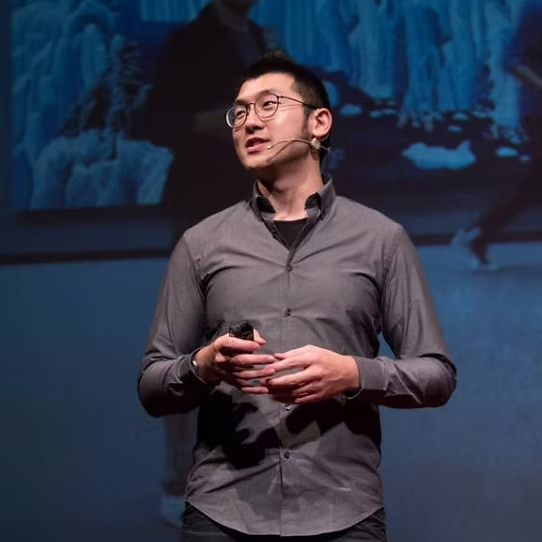
Chong-Xiao ZHENG
Chong-Xiao Zheng’s practice interweaves humor, environmental consciousness, and social reflection. Through his signature alter ego “Pouting Boy” — a cartoonish avatar derived from his own image — Zheng engages in a playful yet critical dialogue between tradition and contemporaneity. By reinterpreting classical Chinese landscape paintings alongside iconic Western masterpieces, he bridges cultural and temporal boundaries to address urgent issues such as ecological preservation, energy crisis, and environmental ethics.
His journey began in 2014, after encountering Fan Kuan’s Travellers Among Mountains and Streams at the National Palace Museum. Moved by the profundity of classical aesthetics, Zheng initiated a project to “remake” historical landscapes, aiming to resonate with younger audiences and to recontextualize traditional painting in a contemporary visual language. This series became a turning point in his career, establishing a conceptual framework grounded in art historical inquiry.
Building on his insights from Chinese painting, Zheng later extended this approach to Western art history, inserting “Pouting Boy” into well-known masterpieces of Western painting. These reinterpretations — both witty and evocative — have resonated strongly with both the art community and the general public, demonstrating not only his deep sensitivity to visual culture across traditions, but also his ability to situate his work within a broader global discourse.
A recurring concern in Zheng’s work is the idea of “being present” within historical narratives. By placing “Pouting Boy” within iconic scenes, he disrupts the authority of the original context while opening up new layers of meaning. The character becomes a time-travelling witness — a visual conduit traversing history, memory, and imagination.
Selected Artorks